Do Emoji Help on Facebook Marketplace? What 8,000 Listings Show
Social media studies say emoji boost engagement. We checked 8,000+ real Facebook Marketplace listings: which emoji sellers use, where, and whether they bring more buyers.
Short answer: emoji don't consistently bring more buyers on Facebook Marketplace. About half of sellers' descriptions use them, mostly as bullet points and labels (✅ 📍 💰). But when the same seller wrote some listings with emoji and some without, there was no consistent difference in how many buyers messaged.
That's a different story from the one social media marketing blogs tell. So we looked at both.
What the social media studies say
If you search for emoji statistics, you'll find big claims:
- "Emoji get Facebook posts 57% more likes and 33% more comments and shares." It's repeated by HubSpot and Sprout Social, among many others. As far as we can trace it, it comes from a study from around 2012 about text emoticons on brand Facebook Pages, before today's emoji and today's News Feed. The original report can no longer be read.
- "Instagram posts with emoji get 48% more engagement." It's cited by Brandwatch, and it comes from a 2017 Quintly study of 5.5 million posts. Quintly's raw figure was 47.7%. After adjusting for account size, its own interaction-rate gap was 15%.
- "241% higher click-through rate." This is a single Facebook ad test, and its author notes it didn't have enough clicks to be statistically significant.
There is better research. A 2023 study in the Journal of the Academy of Marketing Science followed 195,733 Airbnb listings over 26 months. Listings whose title used one emoji that added to the words got about 26% more reviews. But "using multiple substitutive (vs. complementary)" emoji, ones that replace words, reduced reviews, and for premium sellers several emoji hurt "irrespective of their function". Only about 1.3% of Airbnb titles used an emoji at all.
On the sales side, a 2022 study in the International Journal of Consumer Studies found that emoji had a negative direct effect on purchase intention. And a 2025 review of the research called the field "growing in volume yet immature".
Two things are missing from almost all of this: marketplace listings, and buyers rather than likes. That's what we can measure.
Where this data comes from
We looked at 8,115 Facebook Marketplace listing descriptions from 259 sellers and 6,301 listing titles, all written by the sellers themselves: everyday sellers, car dealers and property managers in 2026. We matched each listing to the buyer conversations it brought in. Listings written by our own posting tool are left out.
Emoji go in the description, not the title
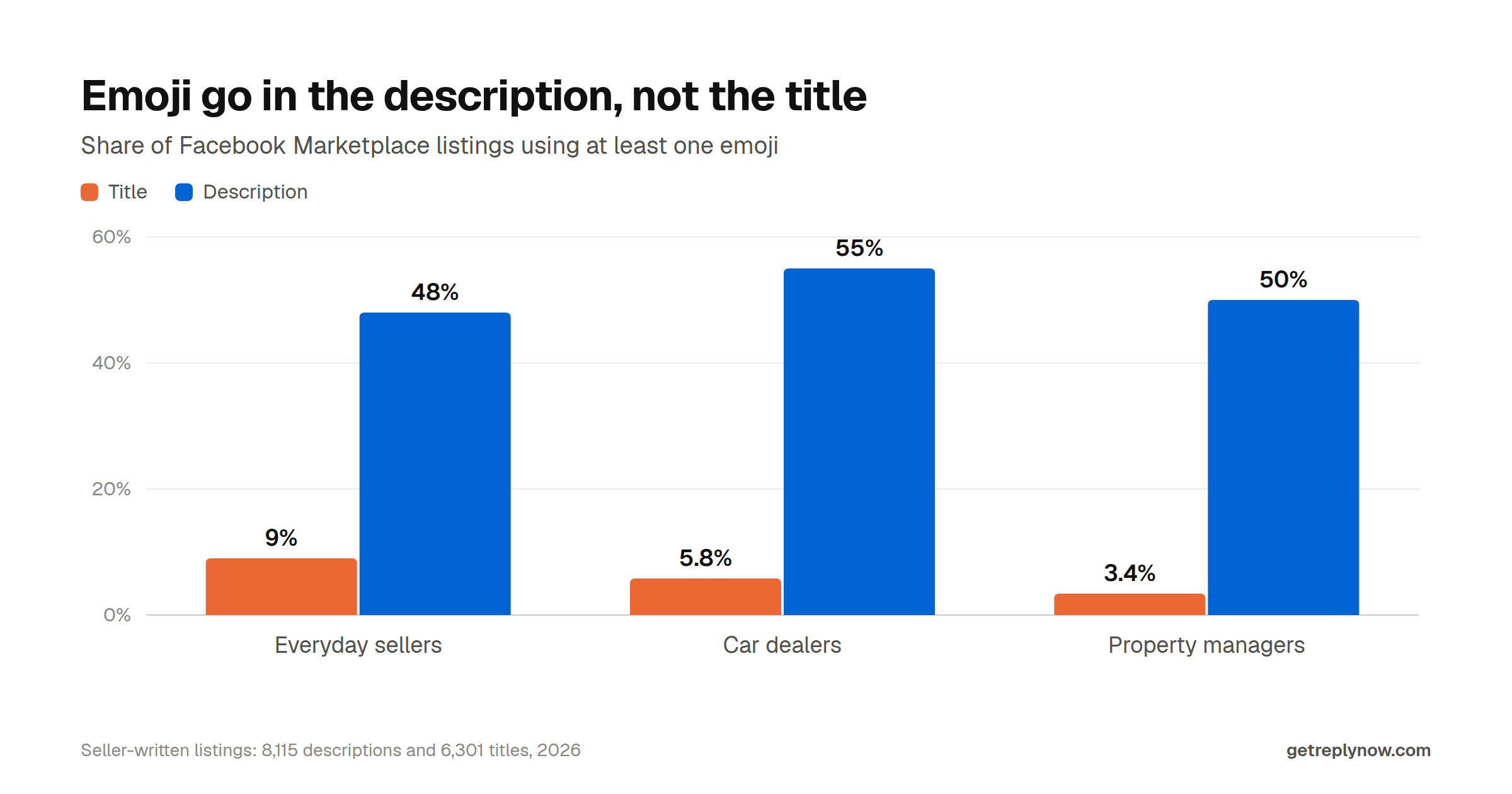
About half of Marketplace descriptions use emoji: 48% for everyday sellers, 55% for car dealers and 50% for property managers. When a description uses them, it uses a lot: about 9 emoji on average.
Titles rarely do: 9% for everyday sellers, 5.8% for car dealers and 3.4% for property managers. That's still well above Airbnb, which doesn't officially allow emoji in titles and where only about 1.3% use one.
Marketplace sellers use emoji as tools
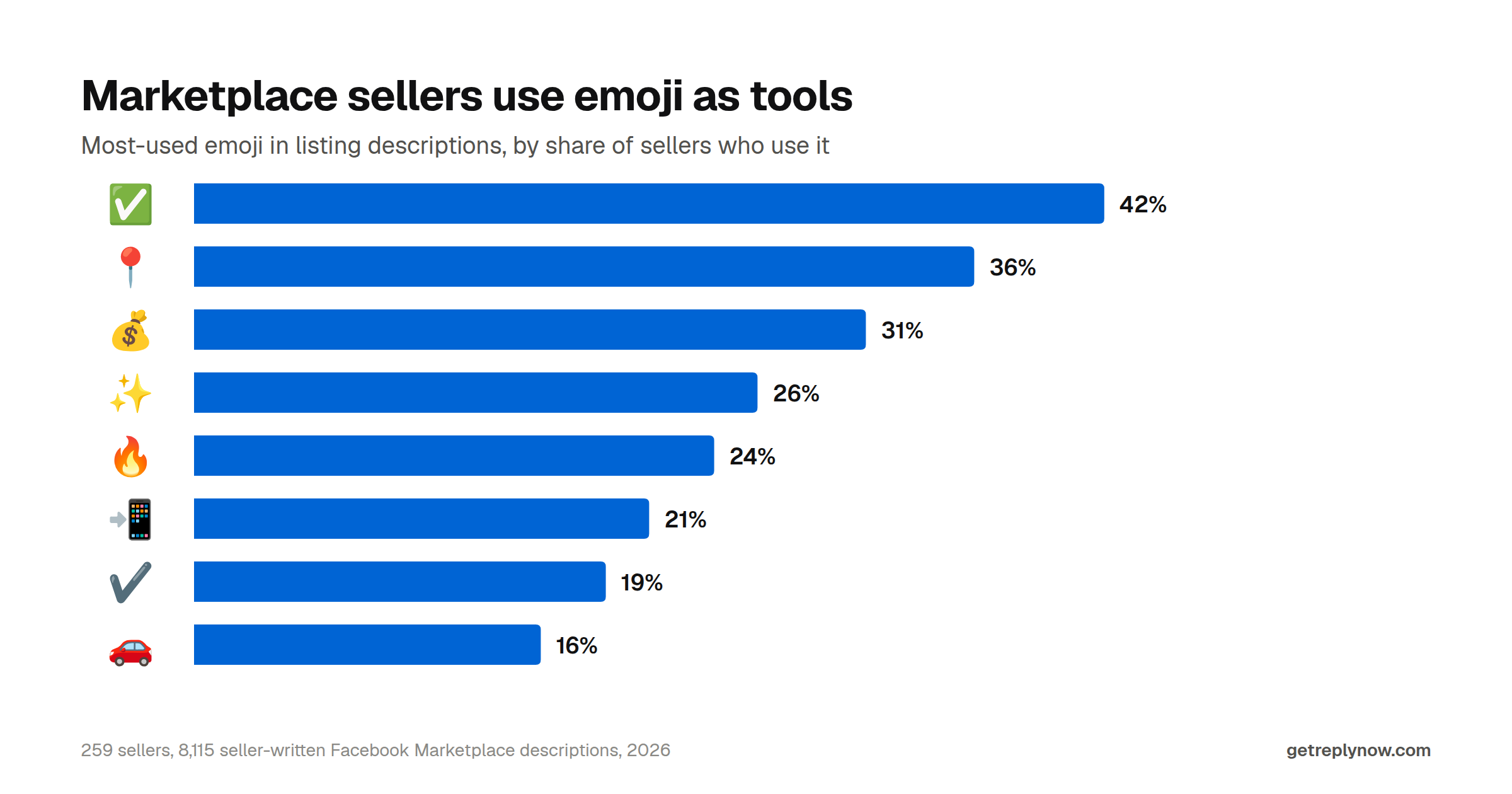
The most common emoji in Marketplace descriptions, by the share of sellers who use each at least once:
| Emoji | Share of sellers | What it's doing |
|---|---|---|
| ✅ | 42% | Bullet point for features ("✅ Clean title") |
| 📍 | 36% | Location |
| 💰 | 31% | Price or financing |
| ✨ | 26% | Highlight |
| 🔥 | 24% | "Hot deal" |
| 📲 | 21% | "Message me" / contact |
| ✔️ | 19% | Another bullet point |
| 🚗 | 16% | Vehicle listings |
Compare that with the rest of the internet:
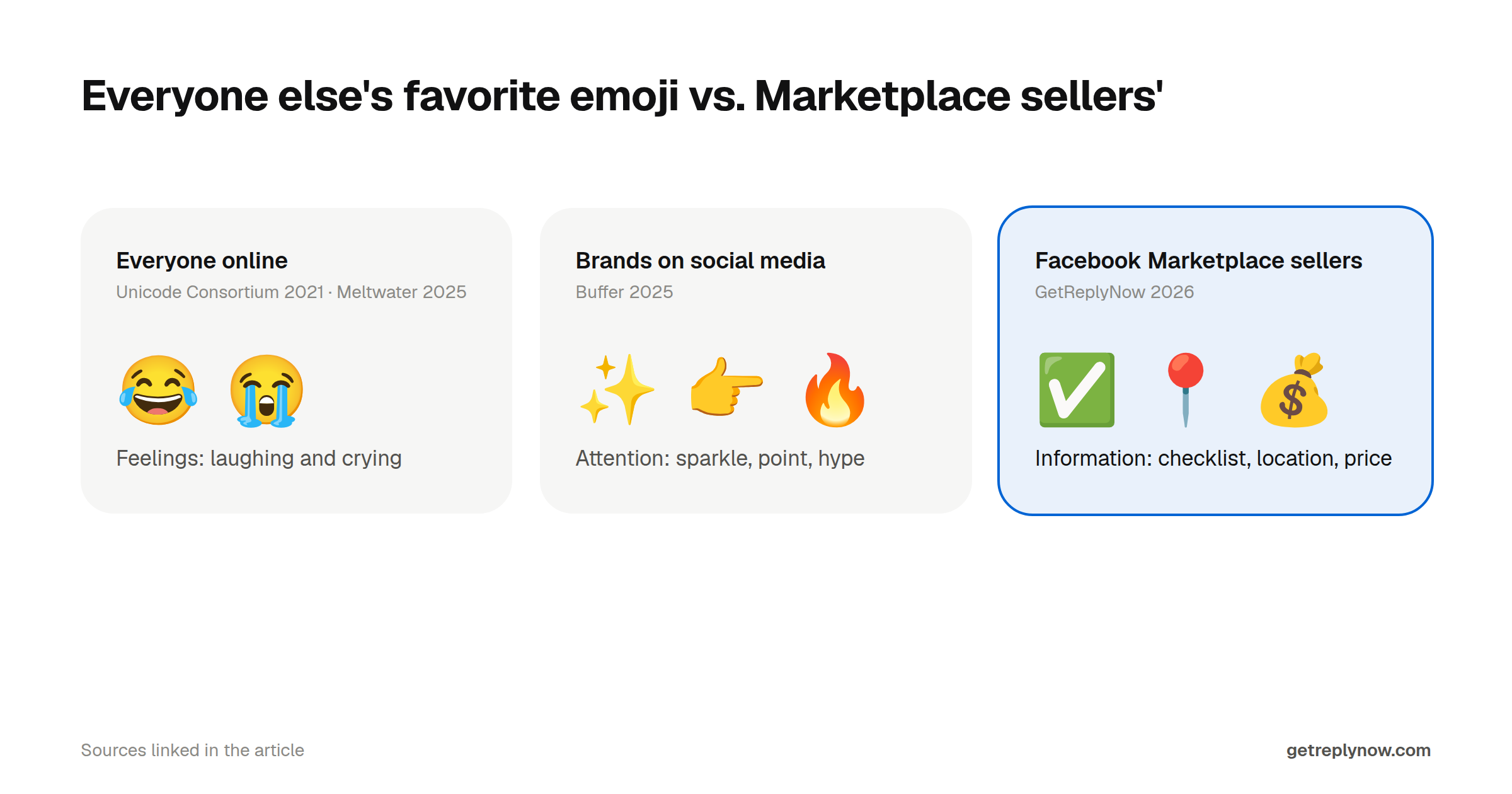
- Everyone online uses emoji for feelings. The Unicode Consortium's 2021 data ranked 😂 first and ❤️ second. Meltwater's 2025 analysis found 😭 is now the most-mentioned.
- Brands on social media use emoji to grab attention. Buffer's 2025 data found ✨ 👉 🔥 at the top and noted that "functional emojis dominate".
- Marketplace sellers go one step further: their emoji carry information. A ✅ is a bullet point, a 📍 is an address, a 💰 is a price. None of the top Marketplace emoji is a face.
Do emoji bring more buyers? No consistent effect
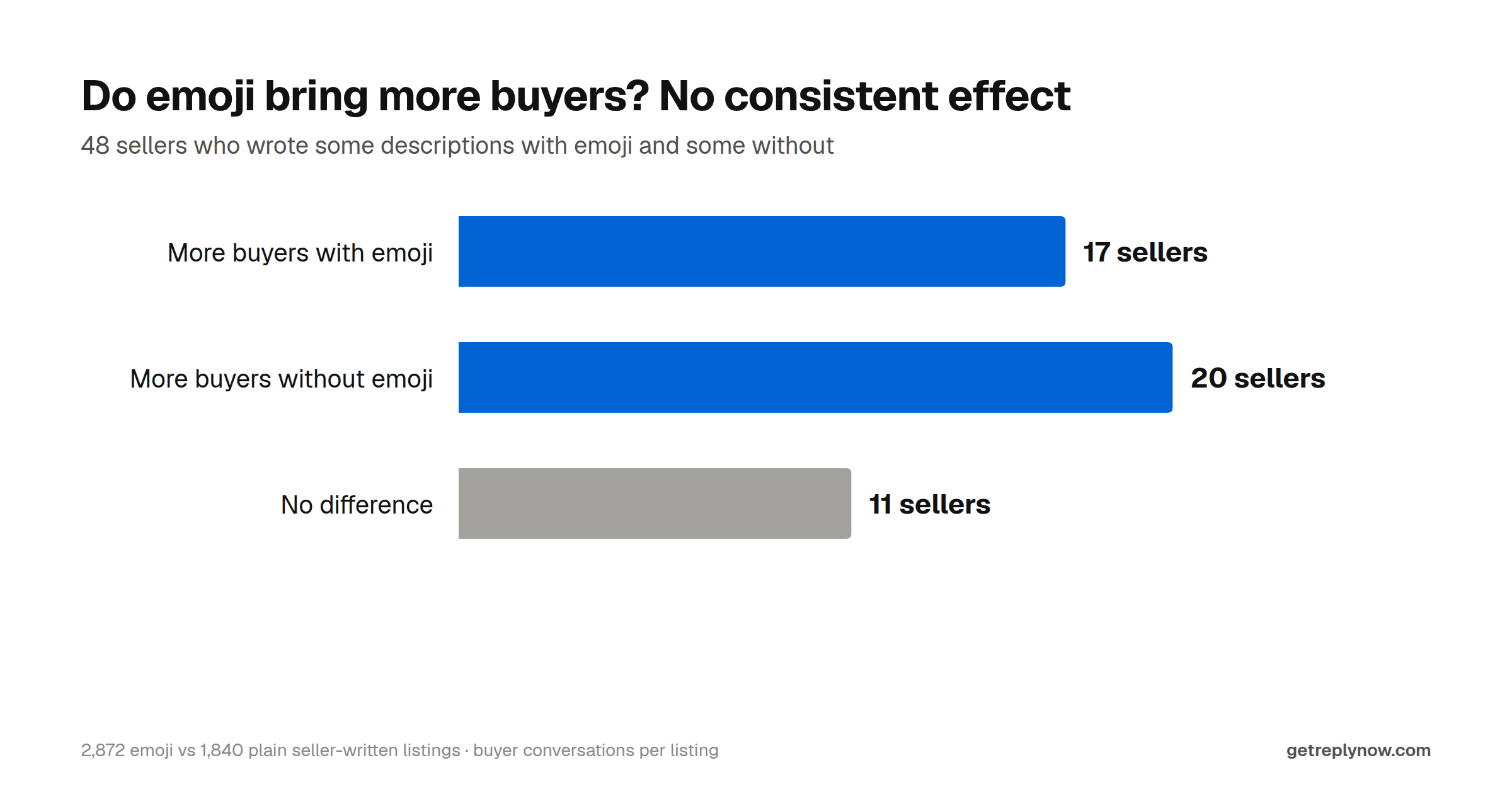
Sellers who use emoji tend to be different kinds of sellers from those who don't, so comparing the two groups directly would mislead. Instead we compared each seller against themselves: 48 sellers who wrote some descriptions with emoji and some without.
- 17 sellers got more buyers per listing on their emoji listings
- 20 sellers got more on their plain listings
- 11 sellers saw no difference
- The median difference was zero
Titles told the same story. Of 14 sellers with both kinds of title, 4 did better with emoji, 6 without and 4 the same.
So if a seller tells you emoji transformed their listings, they may be right about their own listings. Across everyone, it doesn't hold. That fits the Airbnb study: a well-placed emoji can help a little, but a description with nine of them isn't doing extra work.
What actually moves Marketplace buyers
If emoji aren't the lever, what is? From our other Marketplace data:
- Short descriptions. Across 734 car listings, those under 300 characters got about 4× the buyers of longer ones.
- No fake formatting. Facebook doesn't support bold text, so
**CLEAN TITLE**shows the asterisks. Plain text did better. - A specific title. Year, model, size, condition: the words buyers search for.
- Being there when buyers write. 59% of buyers send their first message outside Monday to Friday, 9am to 6pm (see the data).
Should you use emoji in your listings?
Use them if they make your listing easier to read: a ✅ in front of each feature, or a 📍 before the pickup area. That's what most Marketplace sellers already do. Facebook doesn't stop you, and Meta's explanation of how Marketplace ranks listings doesn't mention emoji at all.
Don't expect them to bring buyers. Spend the effort on a clear title, a short description, a fair price and fast replies, especially in the evening and at weekends.
If replying fast is the hard part, GetReplyNow is an AI agent that answers Marketplace buyers instantly, day and night, from your real listing details, and follows up when they go quiet. It's free to start.
How we measured it
- Listings: seller-written Facebook Marketplace listings linked to a Facebook listing ID, 2026. 8,115 descriptions from 259 sellers. Titles come from the seller's live Facebook listings (6,301 titles, since October 2026). Listings posted by our own posting tool are excluded.
- Emoji: any character in the main emoji ranges, counted once per listing for "uses emoji".
- Buyers: buyer conversations matched to the listing's Facebook ID.
- Effect: within-seller comparison, sellers with at least 5 listings of each kind. Listing age isn't controlled, so treat it as correlation, not proof.
Frequently Asked Questions
Do emoji help Facebook Marketplace listings get more buyers?
Not in our data. Among 48 sellers who wrote some descriptions with emoji and some without, 17 got more buyers with emoji, 20 got more without, and 11 saw no difference. The median difference was zero.
How many Facebook Marketplace sellers use emoji?
About half of listing descriptions contain at least one emoji (48% for everyday sellers, 55% for car dealers, 50% for property managers). Titles rarely do: 9% for everyday sellers, 5.8% for car dealers and 3.4% for property managers.
What are the most popular emoji on Facebook Marketplace?
In listing descriptions: ✅ (used by 42% of sellers), 📍 (36%), 💰 (31%), ✨ (26%), 🔥 (24%) and 📲 (21%). Marketplace sellers use emoji as bullet points, location pins, price tags and contact markers.
Is it true that emoji get 57% more likes on Facebook?
That number is widely repeated but traces back to a study from around 2012 about text emoticons on brand Pages, and the original report can no longer be read. It is not good evidence for modern emoji, and it measured likes, not sales.
Should I put emoji in my Facebook Marketplace title?
It's up to you. It's not against Marketplace rules, and Meta has published no guidance either way. In our data emoji neither helped nor hurt. A specific title (year, model, size, condition) and a short description matter more.
Ready to Automate Your Facebook Marketplace Replies?
Your AI agent answers Facebook Marketplace buyers while you're busy. Free credits, no credit card needed.
Related Articles
Facebook Marketplace Works for Car Dealers. Here's Where the Leads Get Lost
Dealers have reported Facebook Marketplace bringing more leads than Cars.com. They've also reported the same problems for years: after-hours buyers, slow Messenger replies, and leads nobody owns. Here's each problem and how to fix it.
Best Time to Post on Facebook Marketplace in 2026 (Data from 20,783 Conversations)
We analysed 20,783 real Facebook Marketplace buyer conversations from 2026. Buyers message steadily from 9am to 11pm, any day of the week. Here's when to post.
Rental Listing Description Examples (and What Renters Really Want to Know)
Copy-ready rental listing description examples, built on what renters actually ask before they book a viewing: move-in date, pets, how to see the place, and whether they qualify. Plus the renter psychology behind each line, and the words to avoid.